
The Future of Motor Control: Mastering the Industrial Motor Starter with Soft Start Technology
In the rapidly evolving landscape of 2026, industrial efficiency isn’t just a goal—it’s a survival requirement. At the heart of this efficiency lies the industrial motor starter with soft start technology. If your facility still relies on antiquated Direct-On-Line (DOL) or Star-Delta starters, you are likely losing thousands in hidden maintenance costs and energy penalties.
As an engineer with over 15 years in power electronics, I have witnessed the transformative shift from mechanical contactors to smart, solid-state solutions. This guide provides an authoritative look at why transitioning to a modern industrial motor starter with soft start technology is the smartest investment your plant can make this year.
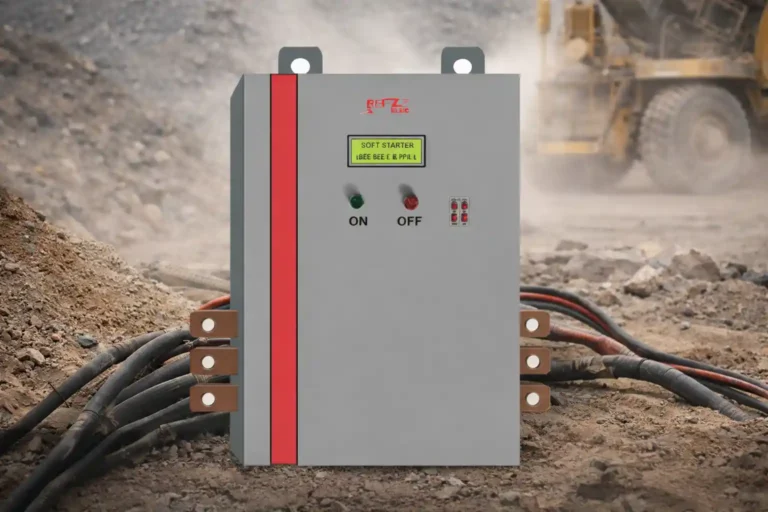
What is an Industrial Motor Starter with Soft Start Technology?
An industrial motor starter with soft start technology is a sophisticated electronic device designed to control the acceleration and deceleration of three-phase induction motors. Unlike traditional starters that “shock” a motor with full voltage instantly, soft starters use Silicon Controlled Rectifiers (SCRs) or Thyristors to ramp up the voltage gradually.
How the Technology Works
The core principle involves “Phase Angle Control.” By precisely timing the firing pulses of the thyristors, the starter limits the initial voltage. As the motor gains speed, the voltage is increased until the motor reaches its rated speed, at which point a bypass contactor often takes over to maximize efficiency.
Why 2026 is the Year for Soft Start Adoption
The global industrial sector is facing stricter “Power Quality” regulations. High inrush currents—which can be 6 to 8 times the rated current—are now heavily penalized by utility providers.
1. Eliminating Inrush Current Spikes
When you use an industrial motor starter with soft start technology, you can limit the starting current to as low as 200-300% of the Full Load Amperage (FLA). This prevents voltage dips that cause lights to flicker and sensitive PLC equipment to reboot.
2. Mechanical Longevity: The “No-Jerk” Policy
Traditional starting methods create a massive “torque spike.” This jerk strains belts, wears down gearboxes, and can snap couplings. Soft starters provide a linear torque ramp, ensuring that your mechanical drive train lasts up to 50% longer.
3. Advanced Protection Features
Modern units in 2026 are no longer just “starters”; they are comprehensive motor protection hubs. They include:
Electronic Overload Protection (Class 10, 20, 30)
Phase Imbalance & Phase Loss Detection
Under-voltage and Over-voltage Trip
Heat Sink Overtemperature Monitoring
Key Applications in Modern Industry
The versatility of the industrial motor starter with soft start technology makes it indispensable across various sectors:
| Application | Benefit of Soft Start |
| Water Pumps | Prevents “Water Hammer” during start and stop, protecting pipes. |
| Conveyor Belts | Stops materials from slipping or falling during sudden starts. |
| Industrial Fans | Reduces belt slippage and mechanical stress on large blades. |
| Air Compressors | Minimizes electrical demand peaks in facilities with multiple units. |
Comparison: Soft Starter vs. VFD
One common question is whether to choose a Soft Starter or a Variable Frequency Drive (VFD).
Soft Starter: Best for applications requiring a smooth start but running at a constant speed. It is smaller, cheaper, and produces less harmonic distortion.
VFD: Best for applications requiring continuous speed control.
For 80% of fixed-speed industrial loads, the industrial motor starter with soft start technology remains the most cost-effective and reliable solution.
Supporting Local Industry
If you are looking for high-quality engineering solutions in West Bengal, finding a reliable motor starter manufacture in Kolkata is crucial for localized support and customized panel building. Local experts understand the specific voltage fluctuations and environmental conditions of the region, ensuring your soft start panels are built to withstand the humid climate while delivering peak performance for your heavy machinery.
FAQs (Frequently Asked Questions)
1. Does a soft starter save energy compared to a DOL starter?
While it doesn’t change the running speed like a VFD, it saves significant energy by reducing the peak demand during startup and eliminating the heat loss associated with high inrush currents.
2. Can I use a soft starter for any induction motor?
Yes, it is compatible with almost all three-phase AC induction motors. However, the sizing must be based on the motor’s Full Load Current (FLC) rather than just Horsepower (HP).
3. What is “Soft Stop” and why is it important?
Soft stop is the gradual reduction of voltage during shutdown. It is critical for pump applications to prevent pressure surges (water hammer) that can burst pipes.
4. Is the installation of a soft starter complex?
Modern 2026 models feature “Auto-Tune” functions. You simply input the motor’s nameplate data, and the microprocessor calculates the optimal ramp time and current limit.
5. How long does a typical soft starter last?
With proper ventilation and dust management, a high-quality soft starter has an operational life of over 10-15 years, significantly longer than mechanical contactors.