
High-Durability Electric Motor Starters for 1-Phase & 3-Phase Industrial Drives
Engineered and manufactured by BeeBee Electricals & Electronics Pvt. Ltd, our industrial electric motor starters provide robust starting, reliable switching, and full-spectrum protection against electrical faults, winding overheating, and severe mechanical drive stress.
• Rating: 0.5 HP to 350 HP (0.37 kW to 260 kW) • Tested to IS/IEC 60947-4-1 Standards
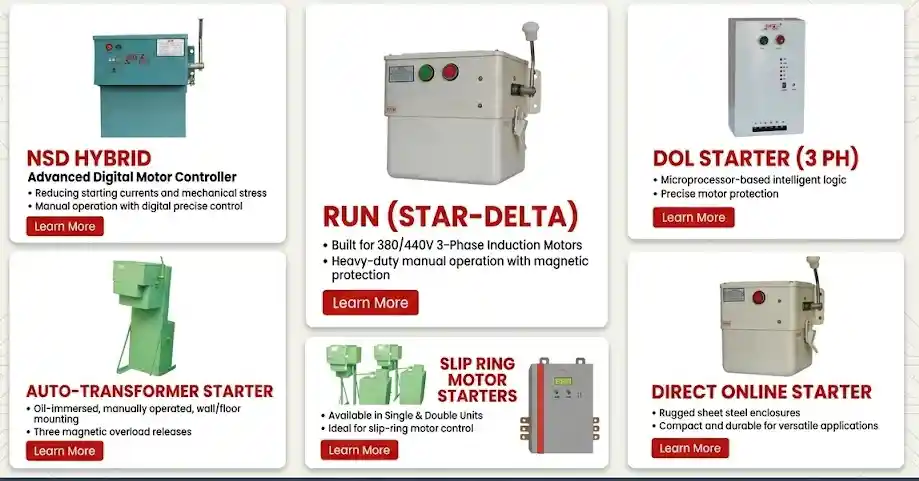
1. Understanding Electric Motor Starters: Working Principle & Engineering Role
An electric motor starter is an integrated electromechanical or solid-state device engineered to safely initiate, sustain, and terminate the power delivered to alternating current (AC) induction motors. While small domestic fractional horsepower motors can occasionally be connected across standard manual switches, industrial three-phase and high-capacity single-phase induction motors demand specialized motor starters to manage severe starting phenomena and prevent catastrophic electrical failure.
When an AC induction motor is stationary and line voltage is abruptly applied, there is no back electromotive force (Back EMF) generated in the stator windings. As a consequence, the motor initially behaves like a short-circuited transformer, drawing a colossal inrush starting current typically 600% to 800% (6 to 8 times) of its rated Full Load Current (FLC). This massive current surge causes instantaneous voltage sags across factory distribution buses, creates severe thermal heating within motor coils, and imparts destructive torque shocks to coupled gearboxes, conveyor belts, and pump impellers.
BeeBee Electricals & Electronics Pvt. Ltd designs and manufactures motor starters that solve these operational challenges by offering three fundamental engineering functions:
- Controlled Starting & Stopping: Providing deliberate, remote, or automated switching capability via heavy-duty electromagnetic contactors or microprocessor-controlled thyristors.
- Inrush Current Mitigation: Utilizing Direct-On-Line, Star-Delta transitions, or solid-state voltage ramping to minimize upstream electrical voltage drops.
- Comprehensive Motor Asset Protection: Continually monitoring operating currents and ambient temperature differentials to disconnect the load prior to winding insulation breakdown caused by sustained overload, locked rotors, phase unbalance, or single-phasing conditions.
2. Complete Classification of Motor Starters Manufactured by BeeBee Electricals
At BeeBee Electricals & Electronics Pvt. Ltd, our manufacturing facility produces an extensive spectrum of standard and custom-engineered motor starters tailored to diverse industrial, municipal, agricultural, and commercial environments.
A. Direct-On-Line (DOL) Starters
The Direct-On-Line starter connects the motor stator terminals directly to the full system supply voltage. Because full line voltage is applied instantaneously, the motor produces maximum starting torque, making DOL starters suitable for machines that require immediate acceleration under mechanical load.
- Horsepower Range: 0.5 HP to 7.5 HP (0.37 kW to 5.5 kW).
- Starting Inrush Current: 100% of direct line current (6x to 8x FLC).
- Starting Torque: 100% of full voltage locked rotor torque.
- Key Applications: Agricultural submersible pumps, bench drills, exhaust fans, centrifugal blowers, small air compressors, and hydraulic power packs.
B. Fully Automatic Star-Delta Starters
For medium-to-large three-phase squirrel cage induction motors, connecting across full voltage causes unacceptable voltage dips. BeeBee Star-Delta Starters mitigate this by initially connecting the stator windings in a Star (Y) configuration during start-up, reducing applied voltage per phase to 58% (1/√3) and inrush current to approximately 33% (one-third) of full DOL values. Once up to speed (~80%), a precision electronic timer shifts the windings into full Delta (Δ) mode.
- Horsepower Range: 7.5 HP to 75 HP (5.5 kW to 55 kW).
- Starting Inrush Current: Reduced to ~33% of direct starting current (approx. 2x to 2.5x FLC).
- Starting Torque: Reduced to 33% of rated starting torque.
- Key Applications: Heavy water transfer pumps, factory refrigeration chillers, textile blowers, plastic injection molding units, and machine tool spindle drives.
C. Solid-State Soft Starters & VFD MCC Panels
When mechanical shock, hydraulic water hammer effects in pipelines, or high-peak power utility penalties must be completely eliminated, BeeBee Solid-State Soft Starters deliver stepless, smooth acceleration. Utilizing anti-parallel Silicon-Controlled Rectifiers (SCRs / Thyristors) on each phase, the controller gradually ramps voltage from an initial preset pedestal up to full line voltage.
- Horsepower Range: 10 HP to 350 HP (7.5 kW to 260 kW).
- Starting Current Control: User-programmable current limitation (100% to 400% FLC).
- Key Features: Controlled deceleration (soft stop), integrated bypass contactors for high operating efficiency, and Modbus RS485 communication.
- Key Applications: Municipal wastewater pumping, slurry handling pumps, cement kiln drives, mining conveyors, stone crushers, and overhead cranes.
3. Technical Specifications & Engineering Matrix
The following engineering matrix details the operational specifications across our standard electric motor starter manufacturing range. All panels are built in ISO 9001 certified facilities and comply fully with national and international switchgear standards.
| Technical Parameter | Direct-On-Line (DOL) | Automatic Star-Delta | Solid-State Soft Starter |
|---|---|---|---|
| Rated Operational Voltage (Ue) | 230V (1-Ph) / 415V (3-Ph) ± 10% | 415V AC ± 10%, 3-Phase | 415V / 690V AC ± 15%, 3-Phase |
| Rated Frequency | 50 Hz / 60 Hz ± 5% | 50 Hz / 60 Hz ± 5% | 50 Hz / 60 Hz ± 5% |
| Motor Power Rating | 0.5 HP to 7.5 HP (0.37 - 5.5 kW) | 7.5 HP to 75 HP (5.5 - 55 kW) | 10 HP to 350 HP (7.5 - 260 kW) |
| Starting Current (% of FLC) | 600% - 800% | 200% - 280% | 150% - 400% (Adjustable) |
| Starting Torque (% of FLT) | 150% - 250% | 30% - 60% | 20% - 100% (Adjustable) |
| Contactor Switching Duty | AC-3 / AC-4 Heavy Duty | AC-3 Continuous Industrial | Thyristor Ramp + AC-1 Bypass |
| Overload Protection Class | Class 10A Bimetallic Relay | Class 10A / Class 20 Bimetallic Relay | Microprocessor-Based Electronic Class 5-30 |
| Phase Protection | Differential Phase Balance | Single Phasing Preventer (SPP) | Digital Phase Loss, Sequence & Asymmetry |
| Ingress Protection (Enclosure) | IP54 / IP65 Powder Coated | IP54 / IP65 Deep-Drawn Steel | IP42 / IP54 Custom Control Cubicle |
| Standard Compliance | IS/IEC 60947-4-1, CE | IS/IEC 60947-4-1, ISO 9001 | IEC 60947-4-2, IEEE 519 |
4. Motor Starter Internal Anatomy & Critical Protection Mechanisms
An electric motor represents a substantial capital investment in any industrial or agricultural operation. Operating without precision protection leads to premature winding insulation degradation, inter-turn shorts, and catastrophic rotor burnouts. Every motor starter engineered by BeeBee Electricals & Electronics Pvt. Ltd integrates multi-tiered protection mechanisms:
A. Bimetallic Thermal Overload Relays (TOR)
The thermal overload relay contains three bimetallic strips heated by individual phase currents flowing through heating coils. When an excessive current flows continuously, the differential thermal expansion causes the bimetallic strips to bend. Once the deflection reaches the calibrated threshold, a mechanical snap-action trip mechanism opens the normally closed (NC) auxiliary contact, de-energizing the main contactor coil and isolating the motor from power.
- Ambient Temperature Compensation: Built-in compensating bimetal elements ensure trip accuracy remains constant between -10°C and +55°C ambient room temperatures.
- Trip Class Certification: Available in Class 10 (tripping within 10 seconds at 600% FLC for standard pump/fan applications) and Class 20 (for high-inertia loads like centrifuges and crushers).
B. Single Phase Preventers (SPP) & Phase Reversal Protection
If one phase fuse blows or a transmission conductor drops while a three-phase motor is running, the motor enters a “single-phasing” condition. To deliver the same shaft torque, current in the remaining two active phases surges by 173% to 230%, causing rapid and localized stator heating. Our electronic Single Phase Preventers detect voltage and current asymmetry within milliseconds, cutting control power before winding temperatures exceed insulation thermal limits.
C. Under-Voltage & Over-Voltage Cutoff
Severe voltage drops force an induction motor to draw higher current to satisfy mechanical load demands, generating excessive I²R resistive heat losses. BeeBee starters feature built-in under-voltage release coils and adjustable voltage monitoring relays that isolate the motor if line voltage falls below 85% or exceeds 115% of nominal ratings.
5. How to Properly Size and Select an Electric Motor Starter
Selecting the appropriate motor starter requires calculating real electrical parameters rather than simply matching nominal horsepower. Follow this step-by-step engineering selection procedure recommended by BeeBee Electricals & Electronics Pvt. Ltd:
-
Obtain Nameplate Full Load Amperage (FLA):
Never size protection based purely on rated HP, because motor efficiency (η) and power factor (cos φ) vary significantly across manufacturers. For a standard 415V, 3-phase motor:
FLA (Amperes) = (Power in Watts) / (√3 × Voltage × Power Factor × Efficiency)
For example, a typical 10 HP (7.5 kW) motor operating at 415V with 0.85 PF and 88% efficiency draws approximately 13.8 to 14.5 Amperes. -
Determine Relay Setting Range:
- For DOL Starters: The thermal overload relay is in series with the line, so the relay setting must be adjusted exactly to 100% of Motor FLA (e.g., 14 Amps).
- For Star-Delta Starters: When the overload relay is placed beneath the main/delta contactor inside the phase loop, the relay only conducts phase current:
Relay Setting = Motor FLA × 0.58 (1 / √3). For a 14A motor, set the relay to 8.1 Amps.
- Evaluate Duty Cycle & Starts per Hour: Standard AC-3 rated contactors are designed for normal motor start/stop operations. If your application involves frequent jogging, plugging, inching, or rapid reversing (AC-4 duty), oversized contactors with higher silver-alloy contact tips must be specified.
- Select Appropriate Enclosure Ingress Protection (IP): Specify IP54 for standard indoor workshops, IP65 weatherproof sheet steel for outdoor agricultural pump stations, or stainless steel enclosures for food processing and chemical manufacturing plants.
6. Industrial Motor Starter Maintenance & Troubleshooting Guide
Regular preventive maintenance ensures that motor starters operate safely for decades without unexpected production downtime. Adhere to this engineering maintenance schedule:
| Observed Symptom | Probable Root Cause | Recommended Corrective Action |
|---|---|---|
| Starter trips immediately on start-up | Short circuit in motor cables, seized pump impeller, or incorrect overload relay setting. | Megger test motor windings; check mechanical shaft free rotation; verify relay dial setting against nameplate FLA. |
| Contactor hums or chatters loudly | Low control coil voltage, dirty pole faces on magnetic core, or broken shading coil. | Measure control circuit voltage; clean dust/rust from armature surfaces; replace contactor coil if defective. |
| Contactor contacts weld or overheat | Severe voltage dip during startup, frequent inching/jogging, or loose terminal lugs. | Check upstream transformer capacity; upgrade to AC-4 duty contactor; torque all terminal screws to manufacturer specs. |
| Overload relay trips after 10-20 minutes | Mechanical overload, single phasing on supply lines, or high ambient temperature. | Measure running currents on all 3 phases with a clamp meter; inspect incoming fuse links; ensure panel ventilation. |
7. Frequently Asked Questions (FAQ) - Electric Motor Starters
Q1: What is an electric motor starter and why can't I just use an MCB?
An electric motor starter is an active switching and motor asset protection system. A Miniature Circuit Breaker (MCB) is designed strictly to protect building distribution cables against dead short-circuits and major ground faults. MCBs cannot detect subtle 10-20% continuous thermal overloads or phase loss that cook motor winding insulation over time. Motor starters incorporate precision thermal or electronic overload relays calibrated to the specific heating curve of the motor.
Q2: What is the main difference between DOL and Star-Delta Starters?
A Direct-On-Line (DOL) starter applies full line voltage immediately upon start-up, resulting in high starting torque but an inrush current of 6 to 8 times the rated current. A Star-Delta starter temporarily connects windings in Star mode during acceleration, reducing starting current and torque to 33% of direct values, before transitioning to full Delta mode for normal operation.
Q3: What types of motor starters are manufactured by BeeBee Electricals?
BeeBee Electricals & Electronics Pvt. Ltd manufactures Direct-On-Line (DOL) Starters, Fully Automatic Star-Delta Starters, Solid-State Soft Starters, Submersible Pump Panels, Auto-Transformer Starters, and complete customized Motor Control Center (MCC) panels.
Q4: How do I order or request a custom quotation from BeeBee Electricals?
You can instantly send your requirements using the online inquiry form below, which connects directly to our sales desk on WhatsApp at +91 9903646469, or by calling us directly for instant factory pricing and technical catalogs.
Send Your Motor Starter Inquiry
Submit your specifications below. Your inquiry will automatically format and open directly in WhatsApp to +91 9903646469 for an instant quotation.